










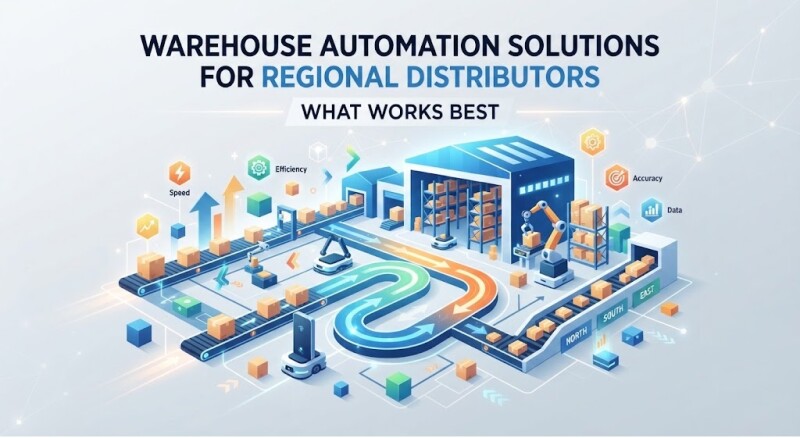
[Article]: Warehouse Automation Solutions for Regional Distributors: What Works Best
Rising order volumes and persistent labor shortages overwhelm manual warehouse processes at regional distribution facilities. As these traditional workflows throttle throughput, they create bottlenecks that prevent growth.
Warehouse automation solutions offer scalable options to eliminate operational constraints without requiring complete facility overhauls.
The Breaking Point for Manual Workflows
Manual processes cannot keep pace with the evolving demands regional distributors face. The shift in buying behavior has fundamentally altered what distributors handle daily.
Customers who once accepted predictable shipments of massive pallets now demand smaller, highly frequent orders with mixed stock-keeping units (SKUs). This transformation stems from what researchers describe as the “Amazon Effect” and the widespread adoption of interconnected inventory strategies across industries.
Regional distributors responded to these market pressures by expanding their product catalogs to remain competitive. Managing thousands of additional SKUs through manual operations creates severe slotting inefficiencies and inventory control problems. Because warehouse aisles become congested with misplaced products, workers struggle to locate items quickly enough to meet accelerated fulfillment timelines.
Since 1985, Fairchild Equipment has navigated these industry shifts and understands the operational strain that regional distribution networks face. Labor shortages complicate the efficient scaling of these manual operations. With labor shortages posing a high supply chain risk, manual operations offer no pathway to compensate for workforce gaps.
Top Warehouse Automation Technologies
Three warehouse automation solutions deliver the strongest returns for regional distributors — automated guided vehicles (AGVs), automated storage and retrieval systems (AS/RS) and warehouse management software (WMS).
These technologies work independently or together, depending on a facility's specific constraints. Regional operators can adopt them without building entirely new facilities because each addresses distinct bottlenecks through phased implementation and avoids the prohibitive costs of comprehensive system overhauls.
AGVs and Mobile Robots
Warehouse throughput improves dramatically when AGVs handle repetitive transport tasks across facility floors without requiring human intervention. Moving materials between receiving docks, storage areas and shipping zones, these systems follow programmed routes or dynamic pathfinding algorithms.
The technology operates around the clock without needing breaks, shift changes or rest periods. This capability maximizes operational hours and extends productive capacity far beyond what manual labor can deliver. AGVs follow precise navigation paths, reducing variability from human operators on board and lowering the risk of product damage during transit.
Deploying AGVs allows warehouse managers to reallocate existing staff toward higher-value tasks that require human judgment and problem-solving skills. Workers can focus on quality control, exception handling and customer communication instead of pushing carts or driving forklifts for hours.
AS/RS
AS/RS technologies and warehouse racking solutions help regional distributors maximize their existing square footage through improved density and vertical utilization. These systems store inventory in compact configurations that would be impractical or unsafe for manual handling.
Facilities can dramatically increase storage capacity without expanding their physical footprint by maximizing vertical height. AS/RS installations can reach ceilings and retrieve items on demand with mechanical precision. This vertical density eliminates the need for costly building expansions when product catalogs grow.
Traditional aisle layouts waste considerable floor area to accommodate forklift turning radii and worker movement paths. AS/RS configurations reduce or eliminate these wide aisles because automated mechanisms require minimal clearance. The savings add up across large facilities and free valuable real estate for additional storage or staging areas.
WMS Integration
Automated hardware elements function as an integrated system when software provides the coordination layer. Real-time visibility into inventory locations, order status and equipment performance across the entire facility comes from WMS platforms.
Optimal storage placement happens automatically when software-driven slotting assigns incoming goods to the most appropriate locations. Product dimensions, turnover velocity and order frequency all factor into the algorithmic placement decisions. Manual storage choices create inefficient gaps and empty areas, but this algorithmic approach maximizes the density of every storage zone.
Overcoming Implementation and Scalability Challenges
Regional distributors often hesitate to invest in automation because they worry about implementation disruption and struggle to justify the return on investment. Large-scale projects with enterprise-level costs make sense for massive distribution centers that can spread expenses across millions of units. Smaller regional operators need a different justification framework.
The minimum viable entry path works best for smaller facilities when it addresses a specific business challenge, such as excessive forklift fuel costs or high turnover on the pack line. This focused approach creates clear before-and-after comparisons without requiring operators to overhaul their entire operation simultaneously.
In the Midwest region, Milwaukee businesses and other operations can find scalable entry points through partnerships with experienced automation providers. Fairchild Equipment specializes in helping regional operators identify warehouse automation solutions that match their current scale and growth trajectory. The company prioritizes right-sized deployments that address immediate operational constraints while preserving future expansion options.
Frequently Asked Questions About Warehouse Automation for Regional Operations
Regional distributors considering automation investments often have similar questions about implementation feasibility and expected outcomes. The following questions address the most common concerns that warehouse managers raise when evaluating these technologies.
What is the typical timeline for implementing warehouse automation?
The scope and complexity of the automation project determine implementation timelines. Smaller focused deployments like AGV systems or software upgrades can go live within weeks or a few months, while more extensive installations involving AS/RS or facility-wide integration may require several months of planning and construction.
How do automated systems handle product variety and irregular dimensions?
Diverse product types work with modern automation technologies through adaptive grippers, adjustable storage modules and intelligent routing algorithms. Product specifications get analyzed by WMS platforms, which then direct items to the most appropriate handling method or storage configuration within the system.
Can automation scale as distribution volumes grow?
Yes. Phased automation approaches allow distributors to add capacity incrementally. Starting with a focused implementation that addresses a specific bottleneck lays the foundation for additional modules and expanded capabilities over time, without requiring a complete system replacement.
Fairchild Equipment supports these scalable deployments through implementation planning that prioritizes throughput improvement at each phase and ensures new modules integrate seamlessly with existing systems.
What happens if automated equipment fails during peak operations?
Well-designed automation implementations include redundancy planning and fallback procedures to maintain operations during equipment downtime. Facilities typically retain some manual handling capability for exception processing and can redirect workflows temporarily while technicians address equipment issues.
Do automation investments reduce overall workforce requirements?
Yes, they can. Automation typically reallocates labor rather than eliminating positions entirely. Workers shift from repetitive physical tasks toward roles that require human judgment, like quality verification, customer problem resolution and system oversight. Some facilities maintain similar headcounts while dramatically increasing throughput capacity.
Build a Future-Proof Distribution Center
Regional distributors that operate with manual workflows may find their growth constrained by throughput limitations and labor availability. Scalable warehouse automation solutions help operators build cumulative advantages in fulfillment speed and operational efficiency.
Fairchild Equipment has helped Midwest distribution facilities smoothly handle these technology transitions and build infrastructure that supports sustained expansion without requiring disruptive overhauls.























Interested? Submit your enquiry using the form below:
Only available for registered users. Sign In to your account or register here.